D&D online
D&D online: a tabletop session or a browser RPG?
Playing D&D online in Polish can mean a session with a Dungeon Master, a shared map on a virtual tabletop, or a computer game using selected rules. These experiences share dice, classes and magic, but serve different needs. This guide will help you choose a way to play and explain where Bractwo Krain fits into the picture.
What does “D&D online” actually mean?
First, decide what you want from an adventure. Do you want to say, “I convince the guard that we are inspectors,” then see the person running the game improvise a response? You are looking for a tabletop roleplaying session. Would you rather open a game, choose a hero and start fighting monsters straight away? A computer RPG may suit you better. The presence of a d20 alone does not mean these two forms of play work identically.
In a traditional Dungeons & Dragons session, participants describe their actions while the Dungeon Master presents the world, runs opponents and resolves situations. When the group meets online, this conversation can take place over voice or text. The computer makes the meeting possible, but people still make the decisions. In a computer game, the world responds through predefined systems: movement, dialogue, quests, combat and available interactions.
| Format | Who runs the adventure? | Who is it for? |
|---|---|---|
| An online tabletop session | The Dungeon Master and party, through conversation | Players who enjoy roleplaying and open-ended solutions |
| A session on a VTT | The Dungeon Master, supported by a map and tools | A party that wants to see positions and track the rules together |
| A computer adaptation | The game system and its prepared content | Players who want to start without organizing a session |
D&D sessions in Polish: conversation comes first
For an online session, the essentials are a shared time slot, a group and someone to run the game. Before your first meeting, agree on the language, rules version and style of adventure. “In Polish” can describe the conversation even if some character sheets or spell descriptions remain in English. Agreeing on terminology helps: the Polish Klasa Pancerza and English Armor Class mean the same statistic, just as k20 and d20 describe the same die.
A short character concept is useful; you do not need a polished history spanning three generations. “I am a Fighter searching for my missing sister, and I distrust the local guards” gives the Dungeon Master something to work with. You can settle the mechanical details together. A beginner does not need to know every spell or remember every rule to take part in the story.
This format shows its greatest strength when an unusual problem arises. A party facing a locked gate can negotiate, find another route, devise a trick or wait for the changing of the guard. The Dungeon Master can assess an idea they did not anticipate. In a computer RPG, the available solutions depend on which interactions have actually been programmed.
VTTs: maps and dice that help the party
A VTT, or Virtual Tabletop, is an online tabletop for running sessions. It is usually used to display maps, move character tokens, roll dice and store information. The amount of automation depends on the tool and its configuration. Do not assume that every platform includes every rulebook or can resolve every situation on its own.
Imagine a battle on a bridge. The map helps establish who is beside the railing, who is blocking the passage and whether the archer can see an opponent. Everyone can see a die roll at the same time. But an attempt to tip a wagon onto the enemies still needs a ruling from the Dungeon Master. The tool organizes space and information; the group creates the story.
For a first session, a simple set of features everyone knows how to use is enough. A shared map and a readable character sheet can be more useful than numerous automations switched on without understanding them. Before the meeting, check your microphone, access to materials and ability to make a test roll. That lets the actual session begin with the adventure.
A computer game using D&D rules: an easy start with defined possibilities
A computer adaptation can retain recognizable elements: attack rolls, Armor Class, damage dice, proficiencies and spell levels. At the same time, it may change the pace, controls or character progression. Before choosing a game, check which rules it actually implements instead of relying solely on the system name in its description.
This kind of game works well when you want a quick visit to a fantasy world. You do not have to wait until everyone has a free evening. You can practice recognizing statistics, try a character and learn why a bonus to hit differs from a damage bonus. That is useful experience, but it does not replace every skill involved in a tabletop session: talking with your party, roleplaying or discussing ideas with the Dungeon Master.
How does Bractwo Krain combine an MMORPG with D&D mechanics?
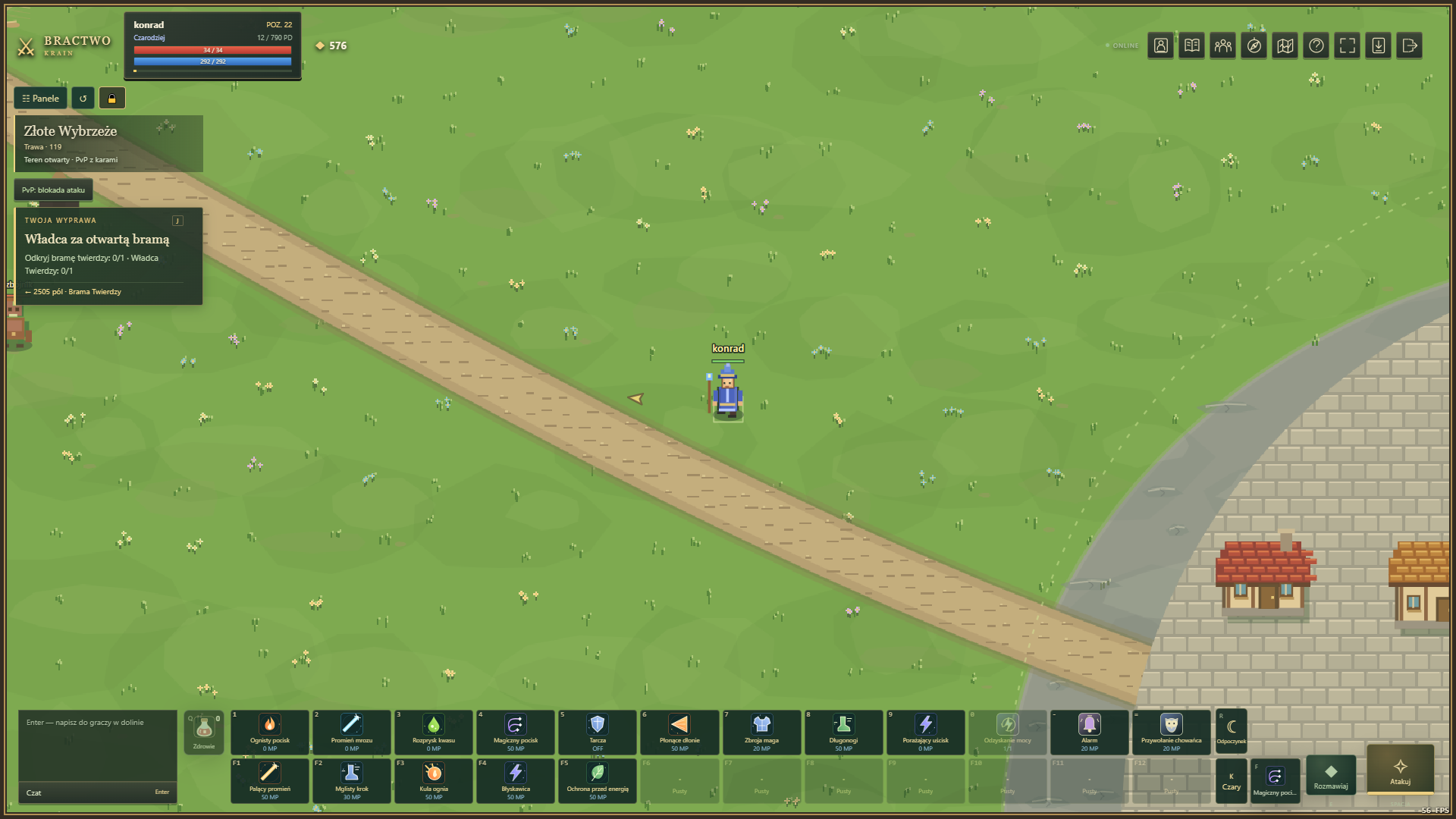
Bractwo Krain is an independent Polish multiplayer browser RPG set in its own world. It uses an adaptation of selected rules from SRD 5.2.1, the publicly available rules document. It is not an official Dungeons & Dragons game or a virtual tabletop for running your own campaign. Its adventures, locations and implemented mechanics form a separate game. The game interface is in Polish.
In practice, you will find the Fighter, Ranger, Wizard and Druid. An attack compares a d20 roll plus a bonus against the target’s Armor Class, while damage comes from actual rolls such as 1d8+3. Spells use mechanics including attacks, saving throws and Concentration. These are concrete connections to the rules that you can understand during an ordinary adventure.
Bractwo also has its own systems. A round lasts three seconds, and mana represents the limited pool of spellcasting resources. Levels 1–20 use D&D experience thresholds. Progression beyond that has no level cap: each level above 20 requires another 50,000 XP. Do not automatically apply every tabletop D&D guide to your character. Read an ability’s description and the Bractwo class guide (in Polish) to understand how it works.
You can explore alone or form a party of up to four players. An expedition together lets you divide responsibilities: one character fights up close, another attacks at range and another uses support magic. Read about the available activities and preparing for dungeons in the world and expeditions guide (in Polish).
How to choose and get started without unnecessary preparation
Choose a tabletop session if your priority is the freedom to try ideas and create a story with other people. Choose a session with a VTT if you also want a convenient way to track the map. Start with a browser game if today you simply want to create a hero and try out their abilities, without finding a Dungeon Master and arranging a meeting for the whole group.
- For a tabletop session: agree on the rules and language, prepare a simple character concept and ask which materials you need.
- On a VTT: check your access to the tabletop and make a test roll before the meeting starts.
- In Bractwo: use the getting started guide (in Polish), learn the controls, complete your first quest and watch the combat results.
You do not have to choose one format forever. Tabletop sessions and computer games can meet different needs on different days. If you start with Bractwo, your next step is the explanation of d20 rolls, AC and critical hits. Later, the guides to magic and spell levels and feats and character progression will be useful.
Sources and scope of this guide
The description of tabletop sessions is based on the official D&D Free Rules: Playing the Game. Information about the rules document was checked against the official SRD overview. The description of Bractwo refers to its implementation and guides, rather than every possibility in tabletop D&D. The source material was verified on October 4, 2026.
Try these rules in Bractwo
Choose a Fighter, Ranger, Wizard or Druid and begin an adventure in this Polish-language browser MMORPG.
Play Bractwo Krain (in Polish)