Character progression
Feats in D&D and Bractwo: how to develop your character
A feat can open up a new way to fight, while improving an ability score can strengthen several important rolls at once. In Bractwo Krain, both choices use the same level-up selection pool, so it helps to understand what will change in the numbers first. This guide explains the differences between D&D ability scores, proficiencies and feats, then turns them into practical decisions for the Fighter, Ranger, Wizard and Druid.
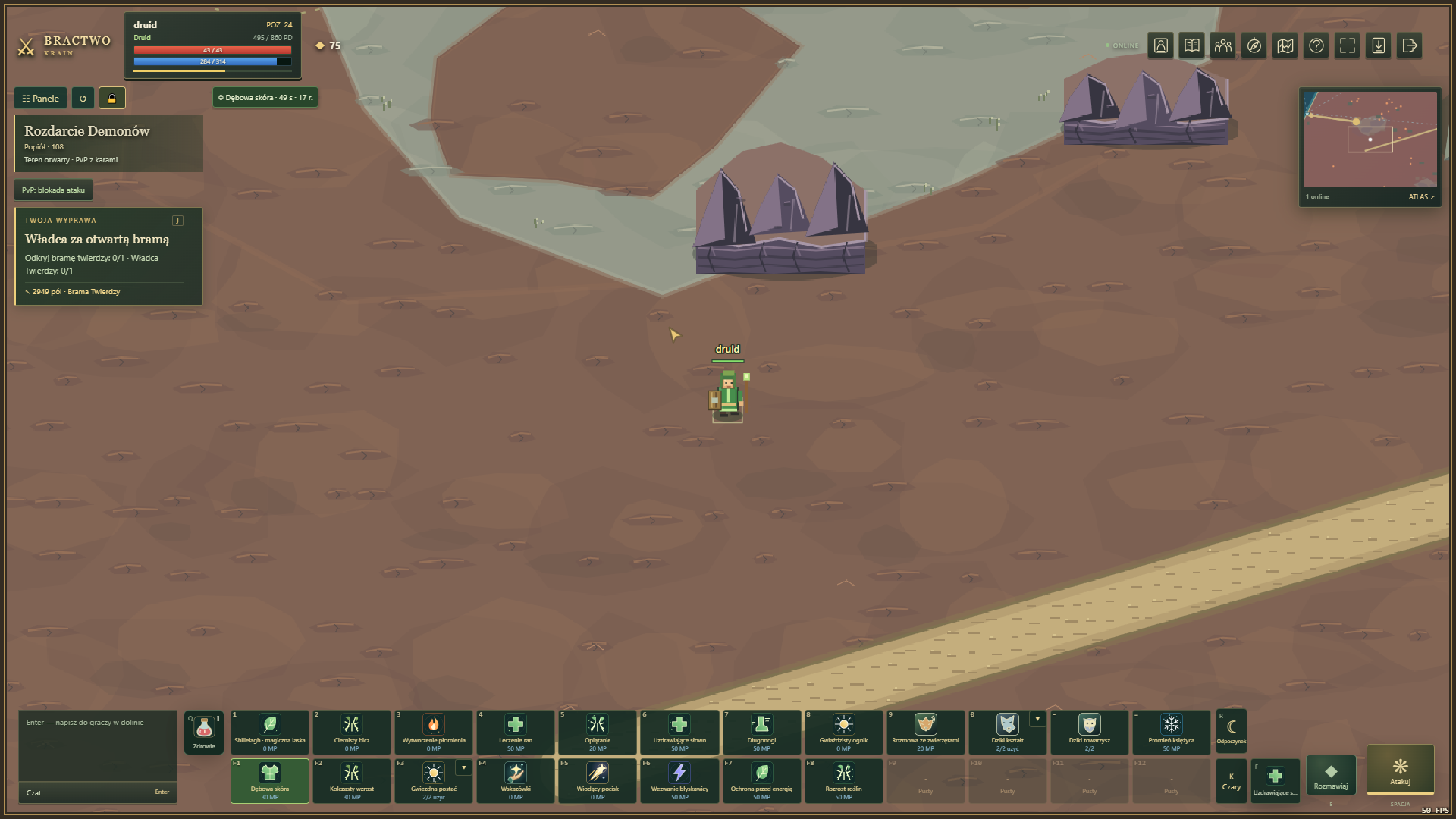
An ability score and its modifier
The six abilities are Strength, Dexterity, Constitution, Intelligence, Wisdom and Charisma. An ability’s score is not a direct bonus to a roll. You add its modifier: subtract 10 from the ability score, divide by 2 and round down. In practice, 14 and 15 both give +2, 16 and 17 give +3, and 18 and 19 give +4.
This explains why a single point sometimes strengthens your character immediately, but sometimes only sets up the next threshold. Raising Dexterity from 15 to 16 increases the modifier from +2 to +3. Raising it from 16 to 17 leaves the modifier at +3. The second change may still be part of your progression plan, but does not immediately add +1 to every Dexterity roll.
In Bractwo, your ability choices depend on your weapon and fighting style: Strength supports attacks with many kinds of melee weapons, while Dexterity supports bows. That applies to both the Fighter and Ranger. Intelligence is key to the Wizard’s magic, while Wisdom is key to the Druid’s. Equipment can change that relationship. A rapier with the Finesse property uses the better of Strength and Dexterity, while a quarterstaff affected by Shillelagh uses Wisdom.
Starting ability scores: 27 points and origin bonuses
A default class allocation applies until you assign your own scores. You can replace it once in the Character Sheet. Point buy requires spending exactly 27 points, with starting scores ranging from 8 to 15. Higher scores cost more: 14 costs 7 points, while 15 costs 9. You are therefore not distributing 27 individual score increases.
Your origin then gives +2 and +1 to two different abilities, or +1 to three. Bractwo lets you choose which abilities receive these bonuses in its origin system. Tabletop D&D ties them to the description of a particular background. You confirm the starting allocation only once, so calculate the resulting modifiers before accepting it.
For example, buying 15, 14, 13, 12, 10 and 8 spends exactly 27 points: 9+7+5+4+2+0. For a Wizard, you could assign 15 to Intelligence and 13 to Constitution, then add +2 to Intelligence and +1 to Constitution. That gives 17 and 14, with modifiers of +3 and +2. Allocate the remaining scores according to your defenses, skills and planned equipment.
Proficiency is not another ability score
Proficiency means training in a specific area. It increases the appropriate roll by a bonus that depends on your character’s progression. Bractwo starts at +2; the thresholds for +3, +4, +5 and +6 are character levels 5, 9, 13 and 17. You do not add this bonus to every action, only to those in which you are actually proficient.
For example, a character with Wisdom 16 has a +3 modifier. Without proficiency in Perception, their basic bonus for the skill is +3. With a +2 Proficiency Bonus, it becomes +5. Expertise doubles the proficiency component, giving +7 in this example. It does not double the whole total or require spending points on every subsequent Perception level.
You choose skills from your class and origin lists. The Ranger gets three class choices, other classes get two, and your origin adds another two. Skilled expands this list with three new skills. Skill proficiency, weapon proficiency and saving throw proficiency are separate: proficiency in Religion does not grant proficiency in Wisdom saving throws.
Your Origin feat and level-up choices
In D&D 2024, feats have categories. An Origin feat describes options available when creating a character; General feats usually require further progression. Ability Score Improvement is also a feat: it gives +2 to one ability or +1 to two, up to a maximum score of 20.
Bractwo keeps a separate, one-time Origin feat selection. It does not consume a choice earned from leveling up. This group includes Tough, Savage Attacker, Skilled, Alert, Crafter, Healer and Lucky. In the level-up pool, you choose either Ability Score Improvement or an available feat; you do not receive both at the same threshold.
| Class | Levels |
|---|---|
| Wizard, Druid, Ranger | 4, 8, 12, 16, 19 |
| Fighter | 4, 6, 8, 12, 14, 16, 19 |
Choosing a Wizard school, Druid circle or Fighter specialization is another separate part of progression. It does not replace a feat. Check the appropriate Character Sheet tab and read the requirements. Training granted by a class does not automatically give the +1 ability increase from a similarly named feat.
Wizard and Druid: spellcasting ability or Concentration?
A Wizard with Intelligence 16 can choose an improvement to 18 and increase the modifier from +3 to +4. Without other effects, this gives +1 to spell attacks and +1 to spell save DC. A Druid gets the same type of improvement from Wisdom. It does not automatically mean +1 damage for every spell: the spell description determines that.
In Bractwo, War Caster gives +1 to Intelligence, Wisdom or Charisma, along with Advantage on saving throws to maintain Concentration after taking damage. At Intelligence 17, choosing +1 immediately reaches the threshold of 18. With Constitution 14 and no extra bonuses, a single Concentration save against DC 10 succeeds 65% of the time; Advantage increases that chance to 87.75%. This calculates one save, rather than guaranteeing you will maintain a spell throughout a fight.
Resilient works differently: it increases the selected ability by 1 and grants proficiency in that ability’s saving throws if your character does not already have it. A Wizard or Druid could consider Constitution, which also supports Concentration. Compare your own modifier, Proficiency Bonus and how frequently you take damage. The magic and spell levels guide explains the spells themselves.
Fighter and Ranger: match your feat to your weapon damage
Piercer suits weapons that deal Piercing damage, such as a bow or rapier. It adds +1 to Strength or Dexterity, lets you reroll a low damage die once per turn, and adds one of the weapon’s dice on a critical hit. You must use the new result, so not every reroll will increase damage. The feat does not strengthen an arbitrary spell simply because it looks like a projectile.
Slasher works with weapons dealing Slashing damage: a normal hit can slow the target, while a critical hit can impose Disadvantage on its attacks for three seconds. Crusher applies to Bludgeoning damage and can push an opponent if the path is clear. Bosses cannot be pushed. Your choice therefore also depends on whether you often fight individual monsters or go on expeditions to fight bosses.
Increasing your main ability is a straightforward alternative. A Ranger who raises Dexterity from 16 to 18 improves bow attacks and damage. The AC benefit depends on armor: medium armor normally counts no more than +2 from Dexterity. Medium Armor Master raises that limit to +3 with Dexterity of at least 16, and itself grants +1 to Strength or Dexterity.
A useful feat does not have to increase damage
In Bractwo, Tough adds 2 HP and another 2 per level, up to a maximum bonus of 40. Healer increases health potion healing by your Proficiency Bonus and allows each 1 on Short Rest dice to be rerolled once. Crafter reduces purchase prices at merchants by 20%, rounding up; it does not change selling prices, services or runes.
Alert is an example of a custom adaptation: here, it increases Perception by your Proficiency Bonus. In tabletop D&D, its effects concern Initiative and the ability to swap Initiative with an ally. A matching name does not mean all effects are identical. Skilled in Bractwo grants skills, rather than the full tabletop selection of skills or tools.
Check three things before confirming
- Calculate whether the ability increase crosses a modifier threshold and improves rolls you actually use.
- Check the feat’s requirements, weapon type, armor and how its resource recharges.
- Choose one problem to solve: missed attacks, broken Concentration, weak defenses, expedition costs or missing skills.
Judge the result across several similar fights. One critical hit or one unlucky save does not prove a progression choice is good or bad. Find the basics of calculating hits in the d20 guide, and a starting point for a new character in getting started in Bractwo Krain (in Polish).
Sources and differences from D&D
Feat categories and ability improvements were checked against the official D&D Free Rules: Feats, while origin fundamentals were checked against Character Origins. The other examples refer to Bractwo’s implementation. They are not a complete list of feats in the rulebook. The article D&D online: a tabletop session or a browser RPG? explains the differences between tabletop sessions and browser games.
Try these rules in Bractwo
Choose a Fighter, Ranger, Wizard or Druid and begin an adventure in this Polish-language browser MMORPG.
Play Bractwo Krain (in Polish)