Combat rules
D20, Armor Class and critical hits: how does combat work?
Why does a hero with a powerful weapon sometimes miss, while a weaker blow can score a critical hit? In D&D-inspired combat, hitting and dealing damage are separate matters. Below, we explain d20 rolls, Armor Class and saving throws through worked examples, then show how these rules work in Bractwo Krain.
Hitting, damage and defense: three different questions
An attack roll determines whether a blow or projectile hits. A damage roll determines how much health a successful action takes away. A saving throw checks whether a threatened target avoids or reduces the consequences of a particular effect. All three can occur in combat, but they are not interchangeable names for the same roll.
For example, a Fighter swings a sword and first rolls a d20 to hit. Only after a successful attack do they roll the weapon’s damage. A Wizard casting a spell that calls for a saving throw works differently: the target rolls its save against the spell’s Difficulty Class. High Armor Class helps against attacks, but does not itself determine the result of that saving throw.
| Type | Example notation | What do you compare it against? |
|---|---|---|
| Attack | d20 + 5 | The opponent’s AC |
| Damage | 1d8 + 3 | Nothing: this is the amount of damage before further effects |
| Saving throw | d20 + saving throw bonus | The effect’s or spell’s DC |
D20 plus a bonus against Armor Class
A d20 has twenty possible results, from 1 to 20. Add your attack bonus to the number rolled. If the total equals or exceeds the target’s AC, the attack hits. With a +5 bonus against AC 15, you need to roll at least 10: a 9 produces 14 and misses, while a 10 produces 15 and hits.
The bonus usually combines the relevant ability modifier with your Proficiency Bonus, if the character is proficient with the weapon. Equipment properties and abilities can provide additional bonuses. In Bractwo, ranged weapons use Dexterity, while Finesse weapons can use the higher of Strength and Dexterity. Spell attacks use the bonus appropriate to the character’s spellcasting.
Why does +5 against AC 15 mean a 55% chance?
Results from 10 to 20 hit: eleven out of twenty possibilities. 11 ÷ 20 = 55%. That is the chance for each independent attack under these conditions. It does not guarantee eleven hits in your next twenty attempts. You might hit several times in a row or miss repeatedly; a larger number of attempts is needed for a meaningful comparison of frequencies.
With the same +5 bonus against AC 17, you need a 12, so nine results hit: 45%. Increasing the bonus to +6 against AC 15 means you hit on a 9 or higher, giving 60%. Here, one point is worth five percentage points. At the extremes, you must also account for the special rules for a natural 1 and natural 20.
A natural 1 or natural 20 is the number on the die
A “natural” result means the number on the d20 before any bonus is added. A natural 1 on a normal attack roll misses, even if the total would otherwise be enough. A natural 20 hits and scores a Critical Hit. By contrast, rolling 15 with a +5 bonus produces a total of 20, but does not make it a critical hit.
For a standard attack without special abilities, a critical hit therefore occurs on one of twenty results: 5%. Special abilities can change the threshold, so read their descriptions. The rules for automatic misses and critical hits do not automatically mean every ability check or saving throw works the same way. The type of roll matters.
1d8+3 becomes 2d8+3 on a critical hit: double the dice
In 1d8+3, the first number tells you how many dice to roll, the second specifies their number of sides, and +3 is a fixed bonus. A normal hit deals between 4 and 11 damage before resistances and other effects apply. Rolling a 6 on the d8 means 9 damage. The d20 used to hit is a different die from the d8 used for damage.
On a critical hit, the basic 1d8+3 becomes 2d8+3. You roll two dice, but the fixed bonus stays at +3. Results of 4 and 7 deal 14 damage. The range is 5–19, with an average of 12; normal 1d8+3 averages 7.5. A critical hit can therefore roll less damage than a very good normal hit.
This matters when comparing weapons. In the example of +5 against AC 15, the expected damage is 4.35 per attack attempt: 50% normal hits averaging 7.5, plus 5% critical hits averaging 12. The remaining 45% are misses. This calculation ignores resistances, additional effects and abilities; it helps explain the difference between the strength of a successful blow and the effectiveness of all your attempts.
Advantage and Disadvantage change which result you use
With Advantage, you roll two d20s and use the higher result. With Disadvantage, you use the lower one. Results of 4 and 17 therefore mean 17 with Advantage or 4 with Disadvantage. Add the attack bonus only to the chosen result; do not add the two dice together.
For +5 against AC 15, Advantage gives a 79.75% chance to hit: missing requires both results to be below 10, and 0.45 × 0.45 equals 20.25%. Disadvantage gives 30.25%, because both results must hit: 0.55 × 0.55. These are our own calculations for this example, without additional abilities that alter the rolls.
Bractwo supports both mechanics. Disadvantage can arise from being Blinded or from a close threat while making a ranged attack; Advantage can apply against an opponent affected by a suitable effect. Multiple sources of Advantage do not add more dice, and simultaneous Advantage and Disadvantage cancel each other out. Check the circumstances of the fight before judging your equipment.
Saving throws against a spell’s DC
Suppose a spell requires a Dexterity saving throw against DC 14. A target with a +2 bonus needs to roll at least 12. Success can mean taking half damage or avoiding an effect, depending on the spell’s description. If the spell deals half damage on a successful save and rolls 17 damage, rounding down leaves 8.
Not every spell requires an attack roll, not every spell allows a saving throw, and not every spell deals damage. In Bractwo, spells resolved through saving throws do not score a critical hit because the target rolls a natural 20. A high saving throw result is a success for the defender, rather than a boost to the Wizard’s attack. The magic and spell levels guide explains further.
How to understand combat in Bractwo Krain
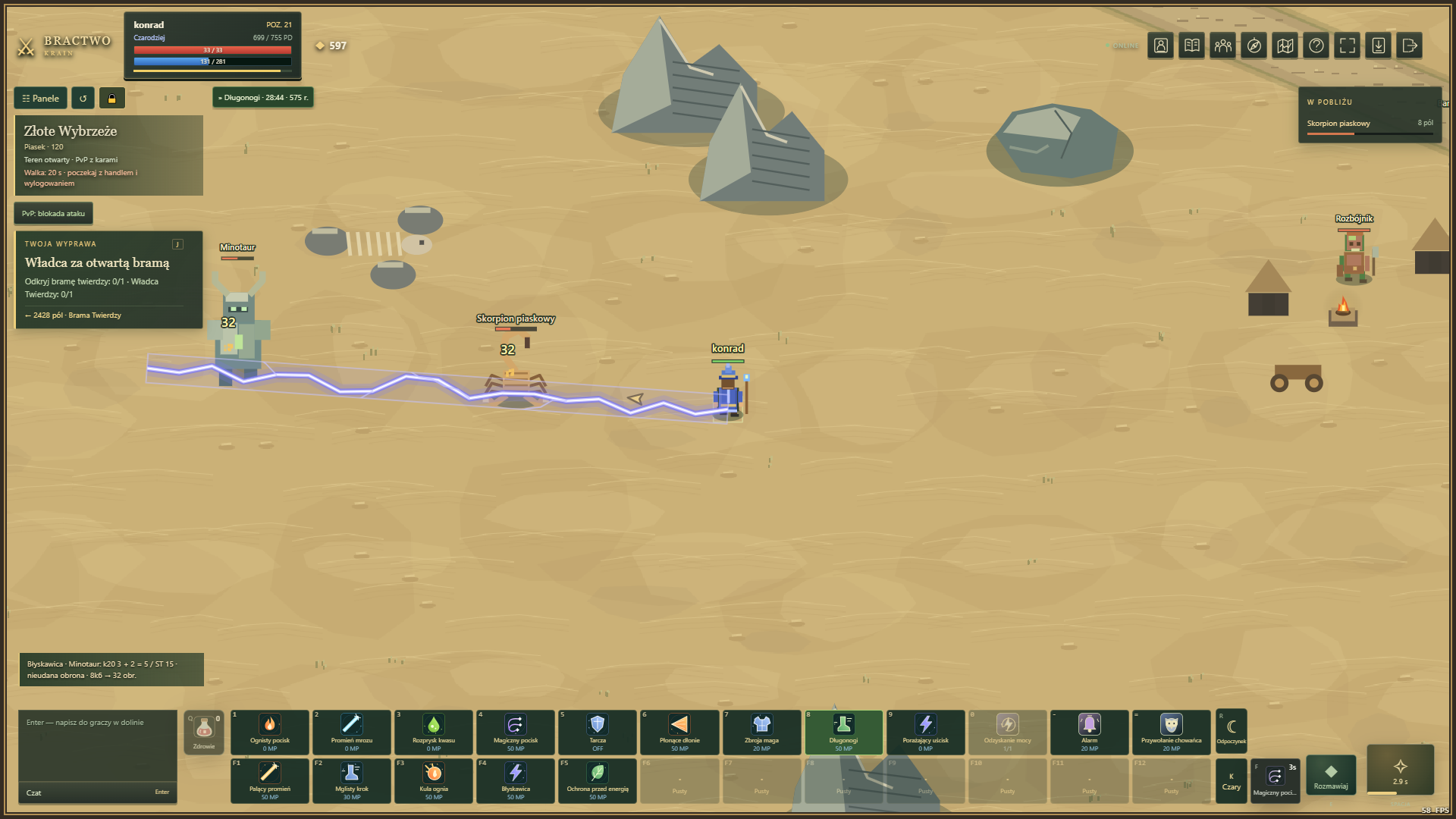
Bractwo is its own adaptation of SRD 5.2.1. Tabletop D&D describes a round as about six seconds; here, the basic round lasts three seconds and the world runs in real time. An attack and a spell requiring your main action share a cooldown. You cannot treat every button press as an additional full turn.
Select a target and make sure it is within range, on the correct floor and not behind an obstacle that blocks the action. Then check the bonus, AC or DC, and the die result. If the attack hits, read the damage and any defensive effects. Animations help you follow events, but do not themselves explain why an attempt succeeded.
- Missing often? Check your bonus to hit, proficiency and Disadvantage.
- Hitting but doing little damage? Check the dice, modifier and target’s resistances.
- Good armor failing to stop a spell? Check whether the spell calls for a saving throw.
- A button press does not immediately produce another attack? Check the cooldown and whether the target is available.
To learn in practice, choose a familiar opponent and compare several fights under similar conditions. Change one thing at a time: your weapon, position or an active effect. The getting started guide (in Polish) explains the controls, while the class comparison (in Polish) describes your characters’ options. Read about later choices in the article on feats and character progression.
Sources and scope of this guide
Attack, critical hit and saving throw rules were checked against the official D&D Free Rules and compared with Bractwo’s implementation. The adaptation is based on SRD 5.2.1. Numerical examples are the author’s calculations and exclude additional abilities unless stated otherwise. The source material was verified on October 4, 2026.
Try these rules in Bractwo
Choose a Fighter, Ranger, Wizard or Druid and begin an adventure in this Polish-language browser MMORPG.
Play Bractwo Krain (in Polish)