D&D magic
Wizard or Druid? D&D magic in Bractwo Krain
The Wizard and Druid share the same D&D foundations: spell levels, d20 rolls and Concentration. In Bractwo Krain, however, they lead to different decisions during an expedition. The Wizard develops the magic of a chosen school, while the Druid combines nature spells, healing and transformations. This guide explains the differences through examples from the game and shows when a stronger spell really is the better choice.
A spell’s level is not your character’s level
In tabletop Dungeons & Dragons, spells have levels from 0 to 9. The Polish term “krąg,” meaning a spell circle, helps distinguish this measure from character level: a level 3 spell is not simply a spell for a level 3 character. Access depends on the progression of the particular class. Cantrips are level 0 spells and have their own scaling rules.
Bractwo uses D&D’s character level numbering. Wizards and Druids gain level 1 spells at character level 1, level 2 spells at character level 3, and level 3 spells at character level 5. Higher spell levels follow every two character levels, up to level 9 spells at character level 17. The Ranger progresses more slowly: level 1 spells at character level 1, level 2 at 5, level 3 at 9, level 4 at 13 and level 5 at 17. Comparing two classes solely by the number beside their name is not very useful.
Cantrips, spell slots and mana
In D&D, spells of levels 1–9 generally consume spell slots, while cantrips do not require one. Bractwo replaces separate slot counters with a shared mana pool. This is its own adaptation for real-time play. Cantrips remain free, while the mana cost of a leveled spell depends on the level at which you cast it.
| Spell level | Cost | Spell level | Cost |
|---|---|---|---|
| 1 | 20 | 6 | 90 |
| 2 | 30 | 7 | 100 |
| 3 | 50 | 8 | 110 |
| 4 | 60 | 9 | 130 |
| 5 | 70 | Cantrip | 0 |
Not every free ability is a cantrip. Transformations may consume Wild Shape uses, while school features can have their own uses. Before a fight, check both the mana cost and the cooldown description. “0 mana” alone does not mean an ability is available without limits.
When should you cast at a higher level?
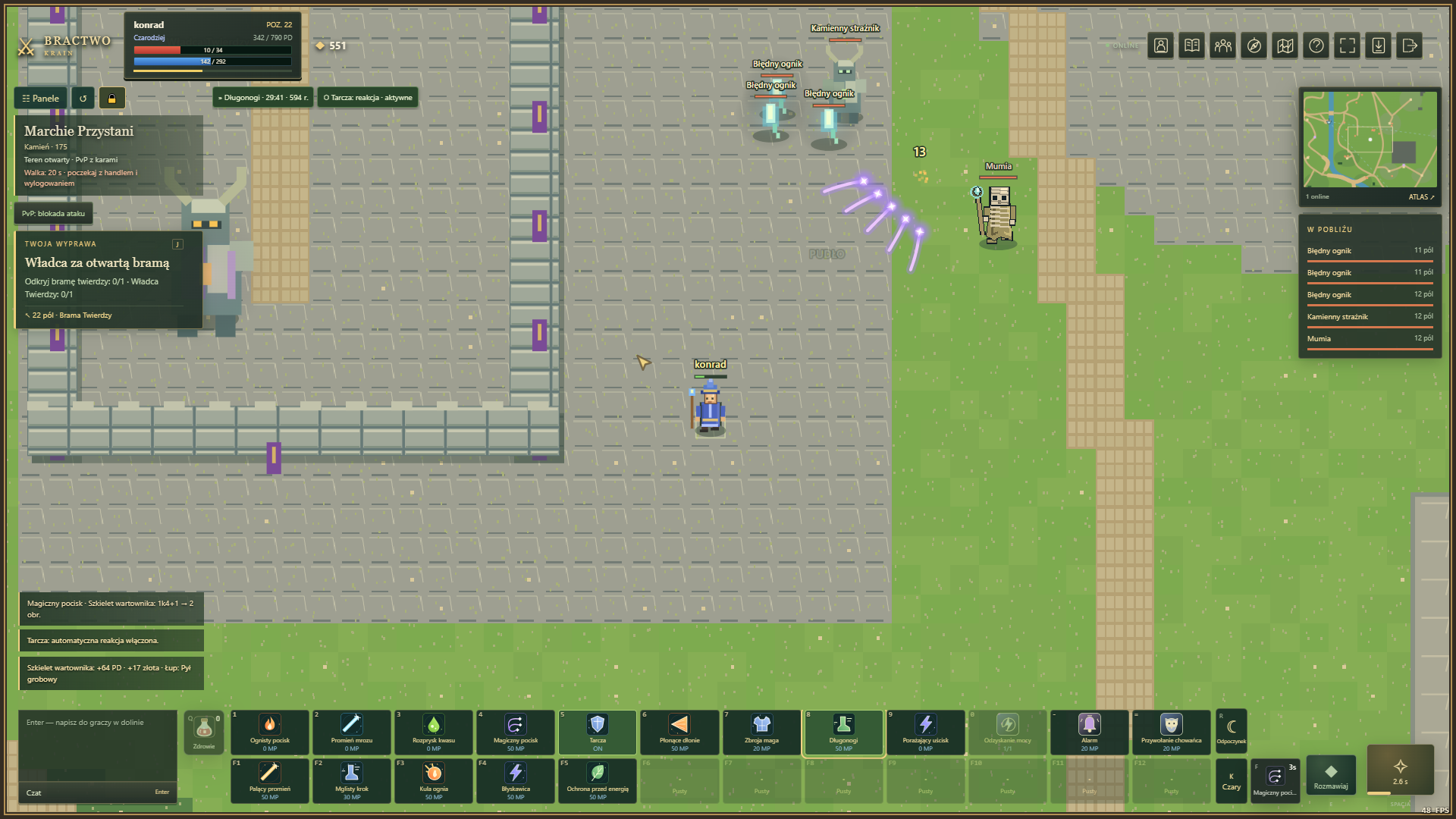
A higher spell level strengthens only spells whose descriptions support that scaling. The Wizard’s Magic Missile starts with three missiles dealing 1d4+1 each. Its level 2 version adds a fourth missile, costing 30 mana instead of 20. That is useful against an enemy you need to finish quickly; against a weak foe, the extra cost may bring no benefit.
The Druid’s Cure Wounds restores 2d8 plus the Wisdom modifier at spell level 1. At spell level 2, it restores 4d8 plus the same modifier. With Wisdom 16, that averages 12 and 21 Hit Points respectively, before other effects. If you are missing only a few HP, the larger spell can easily waste some of its healing.
You can choose the casting level in the spell panel. The automatic setting selects the highest useful version available to your character, taking special free uses into account. Review your favorite spells after unlocking a new spell level: you can keep a cheaper version selected. Cantrips such as Ray of Frost increase their damage dice at character levels 5, 11 and 17 without increasing their mana cost.
A spell attack, a saving throw or an automatic hit?
Ray of Frost requires an attack against Armor Class. With Intelligence 16 and a +2 Proficiency Bonus, a Wizard without other bonuses adds +5 to the d20. A roll of 10 totals 15 and hits a target with AC 15. Read more about this calculation in the combat, d20 and Armor Class guide.
Moonbeam works differently: the target makes a Constitution saving throw against the spell’s DC. A Druid with Wisdom 16 and a +2 Proficiency Bonus has a base DC of 13: 8+3+2. A successful save halves the damage from this area. Magic Missile makes no attack roll, but Shield can stop the volley. “Offensive spell” therefore does not describe a single shared procedure for hitting.
Concentration: one decision sustained over multiple rounds
Bractwo allows you to maintain one spell of your own that requires Concentration. Casting another replaces the previous one. A Druid who casts Moonbeam after Entangle gives up maintaining the roots. While the area remains active, however, the Druid can cast a spell without Concentration if their action, mana and other conditions allow it.
Taking damage triggers a Constitution saving throw. The DC is 10 or half the damage taken, rounded down, whichever is higher. After 12 damage, you therefore need a result of 10; after 30 damage, you need 15. A failed save ends the spell. With Constitution 14 and no additional bonuses, you maintain Concentration against DC 10 on a d20 result of 8 or higher: 65% of attempts. The War Caster feat gives Advantage on these saves.
With Call Lightning, the initial spell costs mana, while subsequent calls during the same maintained Concentration are free. They still require an action. Losing Concentration means starting the spell again will cost mana again. A safe position can therefore save more resources than a small damage increase.
The Wizard: Intelligence and four schools of magic
Intelligence increases your spell attack bonus and spell save DC. From the start, the Wizard has cantrips, level 1 spells, rituals and Arcane Recovery. After a promotion, available from character level 3 through a class trainer, you choose a school in the Character Sheet. This choice is separate from level-up feats.
- Evocation: from character level 3, offensive cantrips deal half damage on a miss or a successful target save, without additional on-hit effects.
- Abjuration: spells of this school that cost mana build a separate magical ward that absorbs damage.
- Divination: Portent lets you prepare a previously rolled d20 result for a specified roll.
- Illusion: Illusory Self imposes Disadvantage on the next attack aimed at you; later progression adds more defensive tools.
Your school affects how you manage actions and resources. An Evoker is more likely to rely on cantrips in ordinary encounters, while an Abjurer plans mana-based protection before a harder fight. The wand’s spark is the focus’s basic attack and does not benefit from bonuses that apply to cantrips.
The Druid: Wisdom, healing and Wild Shape
The Druid chooses either Warden, with training in medium armor and martial weapons, or Nature Mystic, gaining +1 to spell attacks and spell save DC. Nature Mystic is a specific Bractwo adaptation. Both paths use Wisdom. Shillelagh also lets you use Wisdom for attacks with a quarterstaff or club.
Wild Shape becomes available at character level 2. Transforming preserves Concentration, but usually prevents spellcasting. Circle of the Moon allows specific additional spells from its specialization to be cast in Beast form. After promotion, you can choose Circle of the Land, Moon, Sea or Stars. Land develops environment-themed spells, Moon develops transformations, Sea develops an aura and control, and Stars provides three Starry Forms. This is a second choice, independent of Warden or Nature Mystic.
How to prepare a spellcaster for an expedition
Mana does not regenerate automatically. A Long Rest restores your full pool; once between Long Rests, a Wizard can recover some mana after a Short Rest. A Land Druid gains a separate recovery option at a later progression threshold. You can find rest details in the getting started guide (in Polish).
Before setting out, equip a free cantrip, an inexpensive spell for quickly ending a fight, and a defensive tool. A Druid should also check healing and transformation uses. Choose the Wizard if you want to develop a particular school, or the Druid if you want to combine support with several fighting options. The class comparison (in Polish) will help match that decision to your playstyle.
Sources and scope of this guide
The basic terminology was checked against the official D&D Free Rules: Spells, and Concentration against the Rules Glossary. Mana costs, progression thresholds, timings and specialization effects describe Bractwo Krain’s adaptation rather than the full rules of tabletop sessions. If you are only beginning to compare these forms of play, read D&D online: a tabletop session or a browser RPG?.
Try these rules in Bractwo
Choose a Fighter, Ranger, Wizard or Druid and begin an adventure in this Polish-language browser MMORPG.
Play Bractwo Krain (in Polish)